
About Us
Strategic Realignment of Psychiatric Services in Malaysia:
A Tribute to Our History and Charting the Way Forward via the MENTARI Platform
History of Psychiatric Services in Malaysia
The roots of modern psychiatric services in Malaysia trace back to as early as the late 19th and early 20th centuries. At the time, access to basic healthcare infrastructure was limited to the major cities, and was designed to support the economic machinery of the era, such as the rubber, palm oil, and tin mining industries. The earliest documented facility was a rudimentary “lunatic asylum” established at Penang Hospital in the late 1890s, where colonial sailors with mental illness received treatment. Records also indicated a dedicated psychiatric facility at Taiping Hospital in 1910. But it was in 1911, that the colonial government established the Federal Lunatic Asylum in Tanjong Rambutan, Perak, which had 280 beds. It was later renamed the Central Mental Hospital (CMH) in 1928 and grew into a massive 4,000-bed facility. Over the following decades, other institutional hubs were established to manage the growing patient population, including Permai Hospital in Johor, Mesra Hospital in Sabah, and Sentosa Hospital in Sarawak.
During this pre-independence era, mental healthcare remained strictly custodial and isolationist in nature. Patients were kept far away from mainstream medical care, and specialized medical resources were virtually non-existent. In fact, up until Malaysia achieved independence in 1957, the sprawling Central Mental Hospital was managed by just a single expatriate psychiatrist. After achieving independence, the Ministry of Health began a deliberate push toward decentralization. The true turning point for integration occurred in 1958, when the nation’s very first psychiatric ward was opened within a general medical setting at the Penang General Hospital, breaking the tradition of absolute institutional segregation and allowing psychiatric patients to be treated alongside general medical patients for the first time.
Major Milestones in Malaysian Psychiatry
The subsequent evolution of Malaysian mental healthcare is defined by a systematic shift from institutional confinement to community-oriented care. In 1967, Malaysia established its first community-based psychiatric day-care and rehabilitation centre in Ipoh, Perak. Training became more robust, and in 1975, University Malaya (UM) successfully produced the country’s first three locally trained psychiatrists. This reduced the reliance on foreign specialists significantly. By 1998, the Ministry of Health had begun integrating mental healthcare directly into primary care practices across the country, fundamentally altering accessibility.
The absolute crowning milestone came with the enactment of the Mental Health Act 2001 and its subsequent enforcement via the Mental Health Regulations in 2010. This legislation not only dismantled archaic colonial ordinances; it also highlighted and mandated the need for psychiatric services within the community. By legally enforcing the establishment of multidisciplinary community mental health teams, regulating home treatment, and institutionalizing strict legal protections for patient rights, thus began the structural rollout of decentralized care, specifically driving the development of Community Psychiatry Services (CPS), the regulation of Psychiatric Nursing Homes (PNH), and the birth of Community Mental Health Centres, affectionately known as MENTARI. Initially piloting a single branch in 2011, a transformative operational milestone arrived in 2014 when the government approved dedicated funding under Dasar Baru, allowing MENTARI to aggressively scale nationwide and transition its clinical focus from hospital-bound curative care to community-based psychiatric rehabilitation and vocational re-integration.
More recently, a historic milestone was achieved in June 2023 when the Malaysian Parliament officially passed legislative reforms to decriminalize suicide attempts. This reform completely expunged Section 309 of the Penal Code, a century-old legacy of British colonial law that had previously penalized survivors of self-harm with fines or up to a year of imprisonment. Alongside this repeal, the concurrent amendment of the Mental Health (Amendment) Act 2023 transformed crisis management by legally empowering designated crisis intervention officers to rescue individuals in distress, solidifying Malaysia’s institutional framework as a compassionate, healthcare-driven paradigm focused on treatment and rehabilitation.
Taken together, the development of psychiatric services in Malaysia reflects a significant evolution in the national mental health landscape. Services have moved from a predominantly custodial, institution-based model of care towards a more decentralised, integrated, rights-based, and community-oriented system. This evolution is reflected in the expansion of psychiatric services into general hospitals, primary care, community psychiatry, psychiatric rehabilitation, crisis intervention, and MENTARI services, supported by progressive legislative and policy developments over the years.
MENTARI: Advancing Specialised Psychiatric Care Through Community Integration and Digital Innovation
Central to this is the continued strategic evolution of MENTARI, which anchors its core values on advocacy, innovation, and collaboration, as it aspires to enrich an inclusive, multi-layered healthcare ecosystem that transcends standard institutional silos. In doing so, MENTARI cultivates a supportive environment where peers, families, and communities work in unison to help individuals recover and successfully reintegrate into the social fabric. Through heightened public advocacy, MENTARI aims to systematically dismantle structural stigma, while its collaborative frameworks bridge public health architecture with non-governmental organizations (NGOs) as well as the corporate sector. These partnerships actively drive social innovation initiatives, such as the Individual Placement and Support Supported Employment (IPS-SE) framework, thereby transforming psychiatric rehabilitation from a passive clinical routine into a community-supported ecosystem of shared recovery and socioeconomic empowerment.
In order to scale up these community efforts nationwide, MENTARI actively incorporates advanced technology through a highly synchronised, data-driven approach to service planning and delivery. This modernisation is underpinned by the nationwide MENTARI IT System (MITS 2.0), a clinical information system with a centralised, cloud-capable data warehouse designed to systematically evaluate clinical outcomes, vocational rehabilitation milestones, and real-time community service indicators across all 40 centres. By combining this centralised database with emerging digital capabilities, such as mobile health modules, remote monitoring tools, and digital screening portals, MITS 2.0 supports the timely collection and analysis of service data. This facilitates clinical decision-making, programme monitoring, trend analysis, and stronger linkages between health and social services, while supporting a shift from a traditional, reactive model of mental healthcare towards a more agile, data-informed, and predictive approach.
The significance of this work was recognised at the regional level when MENTARI was selected and featured by the World Health Organization Regional Office for the Western Pacific as a case example in the Regional Framework for the Future of Mental Health in the Western Pacific 2023–2030. Presented under the theme “A data-driven approach to community mental health,” MENTARI was highlighted for its use of real-time information to support clinical decision-making, programme development and monitoring, trend analysis, and coordination between health and social services. Its inclusion in this major regional policy framework positions MENTARI as a noteworthy example of how community-based care, social support, employment assistance, and responsive information systems can be integrated within a national mental health service. This robust technological infrastructure enables the Ministry of Health to identify and monitor regional service trends and needs more dynamically and effectively, thereby supporting the strategic allocation of personnel, funding, and community mental health resources.
The Current Landscape of MOH Psychiatric Services
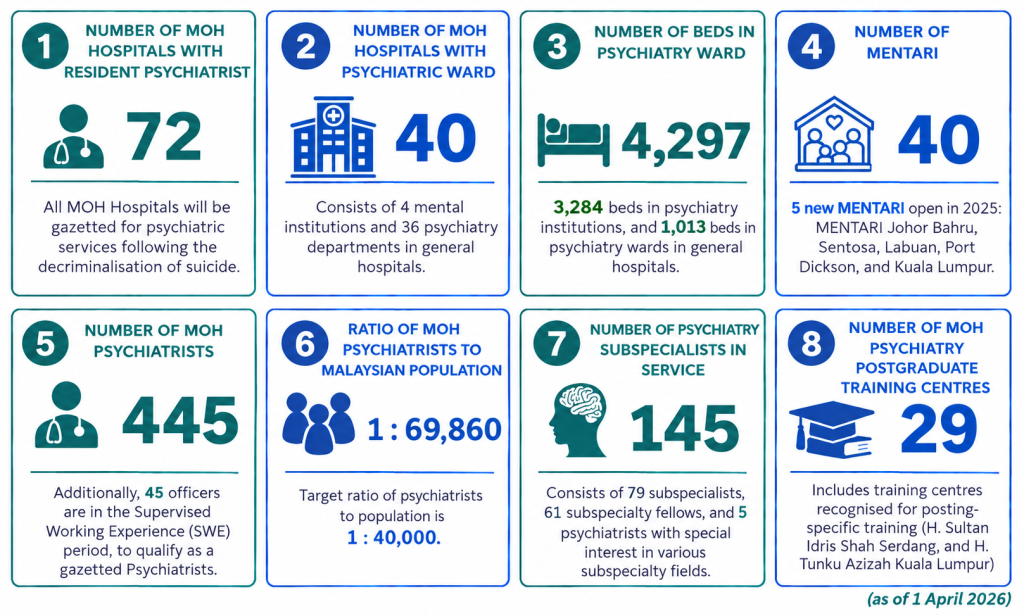
As of 1 April 2026, MOH psychiatric services comprise 72 MOH hospitals with resident psychiatrists, 40 MOH hospitals with psychiatric wards, and 4,297 psychiatric beds, including 3,284 beds in psychiatric institutions and 1,013 beds in general hospital psychiatry wards. The service is supported by 445 MOH psychiatrists who are either registered with the National Specialist Register (NSR) or awaiting registration. This total includes 145 psychiatry subspecialists, subspecialty fellows, and psychiatrists with special interests. In addition to this total, 45 officers are currently undergoing Supervised Working Experience (SWE) to qualify as psychiatrists. Community-based care continues to expand through 40 MENTARI centres nationwide, while postgraduate training is supported through 29 MOH psychiatry postgraduate training centres. The current psychiatrist-to-population ratio stands at 1:69,860, compared with the target ratio of 1:40,000.
Thus far, the journey of psychiatric services in Malaysia reflects a continuing commitment to strengthen mental healthcare as an essential part of the national health system. From its early institutional roots to the present-day expansion of hospital-based, community-oriented, rehabilitative, and crisis intervention services, psychiatry has progressively moved closer to the people it serves. Moving forward, the continued development of psychiatric services will require sustained investment in workforce planning, service integration, data-driven decision-making, inter-agency collaboration, and equitable access across all states and settings. Through this ongoing transformation, psychiatric and mental health services in Malaysia remain committed to delivering care that is accessible, compassionate, rights-based, and recovery-oriented.
References:
- Chong, S. T., Mohamad, M. S., & Er, A. C. (2013). The Mental Health Development in Malaysia: History, Current Issue and Future Development. Asian Social Science, 9(6).
- Data, Innovation, Strategy & Coordination (DISC) Unit. (2026, May). Connect.Psych Bulletin: Psychiatry & Mental Health Services, Ministry of Health Malaysia (Vol. 3, Issue 1) [Unpublished bulletin]. Ministry of Health Malaysia.
- Deva, M. P. (2005). Psychiatry and mental health in Malaysia. International Psychiatry, 2, 14–16.
- Haizan, R. Y. A. (2023). Malaysia passes 3 Bills in parliament to decriminalise suicide attempts. Channel NewsAsia (CNA).
- Ismail, H. (2023). How many doctors do we need in the public sector?: A guide to human resource planning and specialist training. The Malaysian Journal of Medical Sciences, 30(2), 1–7.
- Khan, N. N., Yahya, B., Abu Bakar, A. K., & Ho, R. C. (2015). Malaysian mental health law. BJPsych. International, 12, 40–42.
- Lim, S. L. (2018). Bridging Barriers: A Report on Improving Access to Mental Healthcare in Malaysia. Penang Institute.
- MENTARI Malaysia Official Portal. (2020). About Us: History & Background. Ministry of Health Malaysia.
- World Health Organization Regional Office for the Western Pacific. (2023). Regional framework for the future of mental health in the Western Pacific 2023–2030. World Health Organization.
Mentari Info
MENTARI is a new approach initiated by the Ministry of Health Malaysia (MOH) to improve outreach and re-integration of people with mental health problems into the community.
Total Visitor

Government Website
Contact us
MENTARI HQ @ Selayang
LG Lot 25B,26,27 Selayang Capitol Kompleks, Selayang – Kepong Highway, 68100 Kuala Lumpur
03-6127 0946